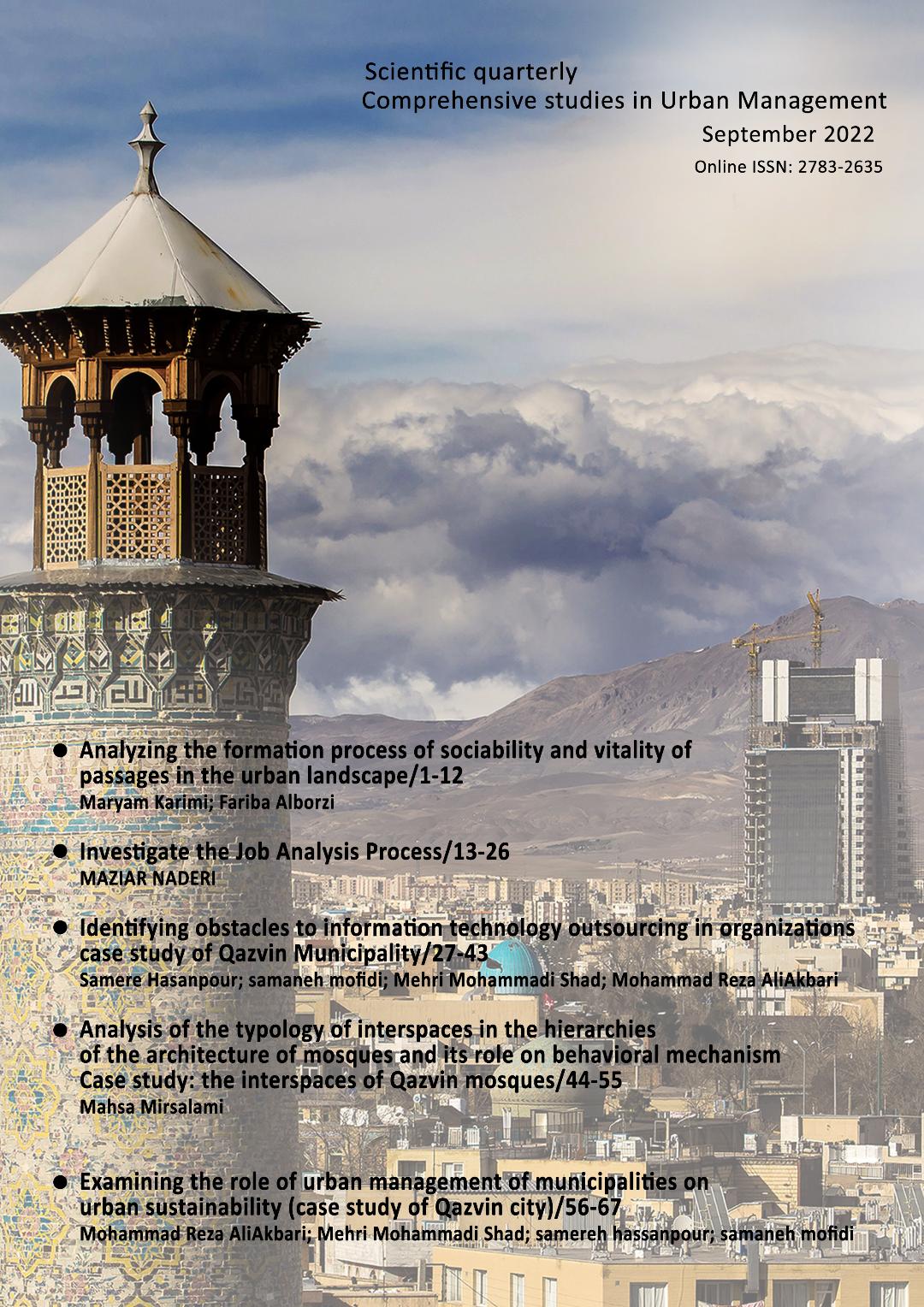
Analysis of the typology of interspaces in the hierarchies of the architecture of mosques and its role on behavioral mechanism (Case study: the interspaces of Qazvin mosques)
Document Type : ُScientific
Author
Editor of the specialized quarterly comprehensive studies in urban management
Abstract
Hierarchy is one of the principles governing collections, components and phenomena that either exist naturally in the universe as a whole or are designed and created by human hands. In traditional Iranian architecture, every space has its own special identity. Since entering the space, different parts have been placed one after the other to form the body of the complex by creating a proper spatial hierarchy. Interstitial spaces forming hierarchies in the body have a two-faceted nature in the direction of connection, communication and having multiple concepts and meanings. Since mosques are considered as one of the most important elements of the identity of an Islamic city and as a collective place, and on the other hand, one of the aspects of the dynamic relationships and interactions of the mosque is the spatial characteristics of the architecture and the type of relationships and its spatial arrangement, so the present research focuses on the role of interspaces. In the body of architecture and its role, it deals with the collective structure of mosques. Data collection, activity tracking and fieldwork techniques have been studied in three mosques in Qazvin city, and in order to investigate the role and position of the interstitial space from a structural point of view, the theory of space syntax has been used with depthmap10 software using spatial layout indicators. And if the above method alone cannot be used to qualitatively evaluate the weight of the components that affect the performance of the collective space, then for the correctness of the syntax data, the components are subjected to correlation analysis through a questionnaire and through the Spss22 statistical software.
The results indicate that; The presence of intermediate spaces causes spatial separation, territorialization in different areas in the mosque, which has an optimal effect on the mechanism of collective spaces, so that they respond to users from a range of solitude to collective territory, which can attract more people to the mosque. The space of the mosque.
The results indicate that; The presence of intermediate spaces causes spatial separation, territorialization in different areas in the mosque, which has an optimal effect on the mechanism of collective spaces, so that they respond to users from a range of solitude to collective territory, which can attract more people to the mosque. The space of the mosque.
Keywords